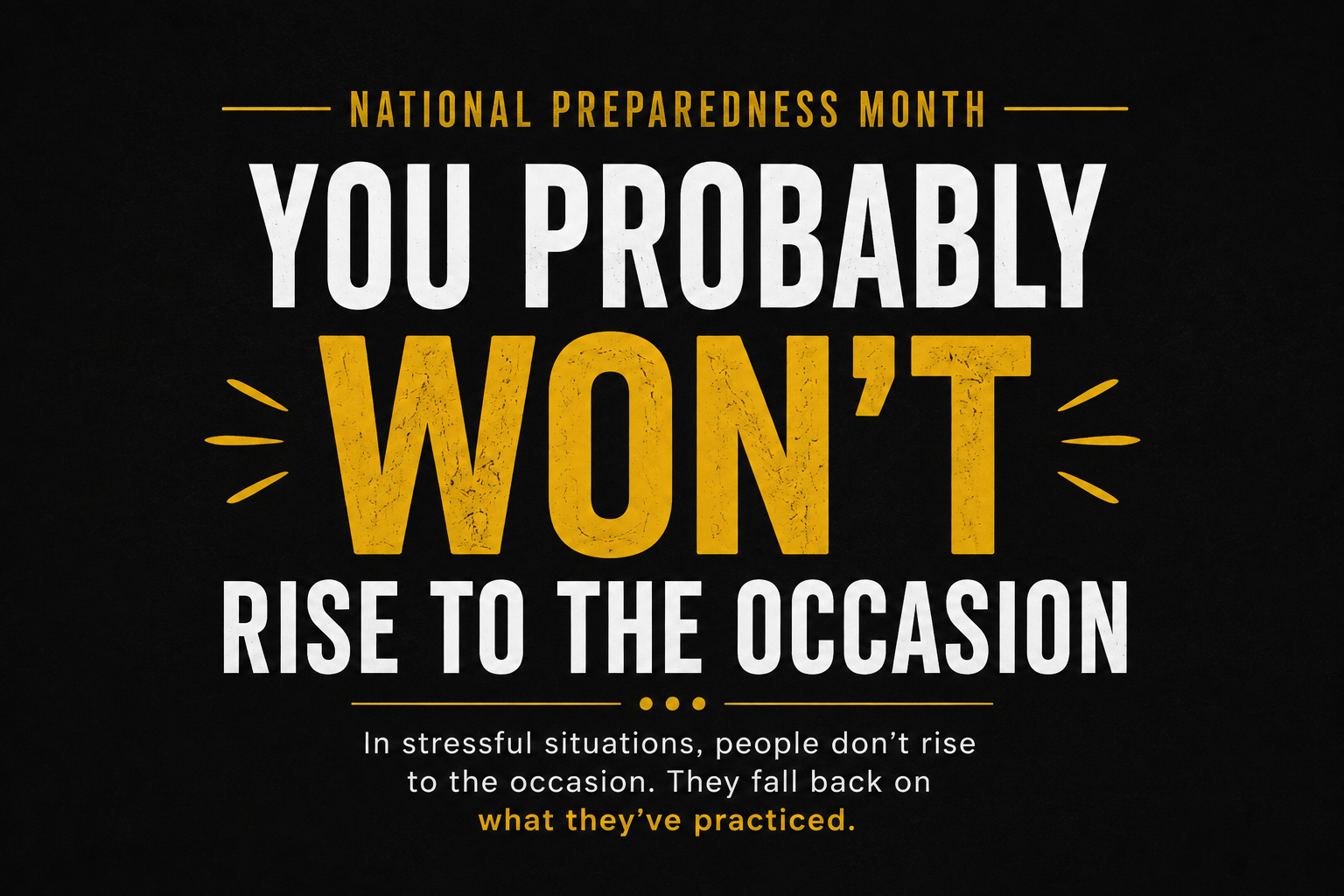
You Probably Won’t Rise to the Occasion
Emergency kits and evacuation plans matter, but preparedness also means knowing how you will respond when your heart is racing and your plan stops working. Jiu Jitsu, Muay Thai, and practical self-defense give students a chance to experience real resistance and practice staying functional under pressure, so they have a reference point instead of a guess.
There’s a phrase we hear all the time when something goes wrong:
“I’d know what to do.”
Maybe you would.
But under real pressure, people rarely become calmer, sharper, stronger versions of themselves simply because the moment demands it.
More often, we fall back on what we’ve practiced.
September is National Preparedness Month, which usually brings conversations about emergency kits, evacuation plans, smoke detectors, flashlights, food, water, and knowing what to do during a disaster.
All of those things matter.
But there’s another kind of preparedness that’s harder to put in a backpack:
How do you respond when your heart is racing, your thinking gets messy, and something happens that you weren’t expecting?
Stress Changes the Equation
It’s easy to imagine how we would respond to a stressful situation while sitting comfortably and thinking clearly.
Reality is different.
When your brain perceives a threat, your body can respond almost immediately. Your heart rate increases. Your breathing changes. Your muscles tense. Your attention can narrow.
You may fight. You may run. You may freeze.
And suddenly, something that sounded incredibly simple five minutes ago doesn’t feel so simple anymore.
“Stay calm.”
“Move.”
“Get away.”
“Protect yourself.”
“Call for help.”
Knowing those things intellectually and being able to do them while your nervous system is sounding every alarm it has are two very different skills.
That’s where training matters.
You Can’t Predict the Situation. You Can Prepare Your Response.
Good preparedness isn’t about rehearsing every possible bad thing that could happen.
That’s impossible.
It’s about developing responses that remain useful when circumstances change.
This is one of the most interesting things about martial arts.
A technique can be demonstrated perfectly in a quiet room. You can understand exactly where your hands go, where your feet belong, and what should happen next.
Then your training partner starts resisting.
Everything changes.
They move.
You lose your balance.
The first thing you tried doesn’t work.
You get tired.
You forget something your coach explained 30 seconds ago.
Now you have to solve the problem.
That resistance is important because real life doesn’t cooperate with your plan either.
Pressure Is Something You Can Practice
One of the unique things about Jiu Jitsu, Muay Thai, and other combat sports is that they allow people to experience controlled pressure.
Not imaginary pressure.
Someone is actually trying to stop you.
A training partner may be trying to pass your guard. Escape your position. Land a controlled strike. Prevent you from doing exactly what you’re trying to do.
Your heart rate climbs.
You get uncomfortable.
Sometimes you panic.
And then something interesting happens.
You do it again.
Over time, situations that once felt overwhelming become familiar.
You learn to breathe.
You learn that being uncomfortable doesn’t automatically mean you’re in danger.
You learn when to keep fighting for something and when to change strategies.
You learn that panic burns energy remarkably fast.
Most importantly, you learn that staying functional under pressure is a skill.
Prepared Doesn’t Mean Fearful
Preparedness can sometimes sound like expecting something terrible to happen.
That’s not the point.
We wear seat belts without expecting to crash.
We teach children fire drills without expecting their school to catch fire.
We learn CPR hoping we’ll never need to perform it.
Preparation isn’t fear.
It’s simply acknowledging that knowing what to do before something happens is better than trying to figure everything out for the first time while it’s happening.
Self-defense should be approached the same way.
The goal isn’t to walk around looking for threats.
In fact, some of the most important skills have nothing to do with throwing a punch or finishing a submission.
Awareness matters.
Recognizing when something feels wrong matters.
Creating distance matters.
Using your voice matters.
Knowing when to leave matters.
And if physical action ever becomes necessary, having previously experienced resistance and pressure can matter too.
The Goal Isn’t to Become Fearless
Training doesn’t make someone immune to fear.
Experienced martial artists still feel adrenaline. Competitors still get nervous. Coaches can still find themselves uncomfortable.
The difference is familiarity.
You’ve been tired before.
You’ve had someone bigger than you putting pressure on you before.
You’ve been stuck.
You’ve made bad decisions.
You’ve recovered.
You’ve learned that the first solution doesn’t always work.
And you’ve practiced continuing to think anyway.
That experience can’t guarantee how anyone will respond in a real emergency. Nothing can.
But it can give you something more useful than confidence based purely on imagination:
a reference point.
You’ve been under pressure before.
And you know you can function there.
So, Are You Prepared?
National Preparedness Month is a good reminder to check the batteries in the flashlight, update the emergency contacts, replenish the first-aid kit, and make sure everyone in the family knows the plan.
But maybe it’s also worth asking a different question:
What have I actually practiced?
Not what have I watched.
Not what have I read.
Not what do I think I would do.
What have I practiced enough that I could access it when I’m tired, surprised, nervous, or uncomfortable?
Because when pressure arrives, none of us gets to choose the perfect conditions.
And you may not suddenly rise to the occasion.
You may simply fall back on your training.
At Evolve Training Center, that’s one of the reasons we believe training should go beyond learning techniques. Through Jiu Jitsu, Muay Thai, and practical self-defense, students have opportunities to problem-solve, experience resistance, manage pressure, and become more comfortable navigating uncomfortable situations.
Hopefully, you’ll never need those skills anywhere except the training room.
But that’s kind of the point of being prepared.